Science Behind Car Polishing and Paint Correction
Modern automotive paint is a layered system: primer for adhesion, basecoat for colour, and a clear coat on top for gloss and protection. Polishing works almost entirely in the clear coat, using micro-abrasives to remove a very thin layer so defects in that outer surface are levelled out. Paint correction is the more intensive, multi-step version of this process, combining compounding, polishing, and refining stages to deal with deeper, more numerous defects.
For clear-coat safe polishing packages and detailing, see: Car Spa & Cleaning Services in Jaipur
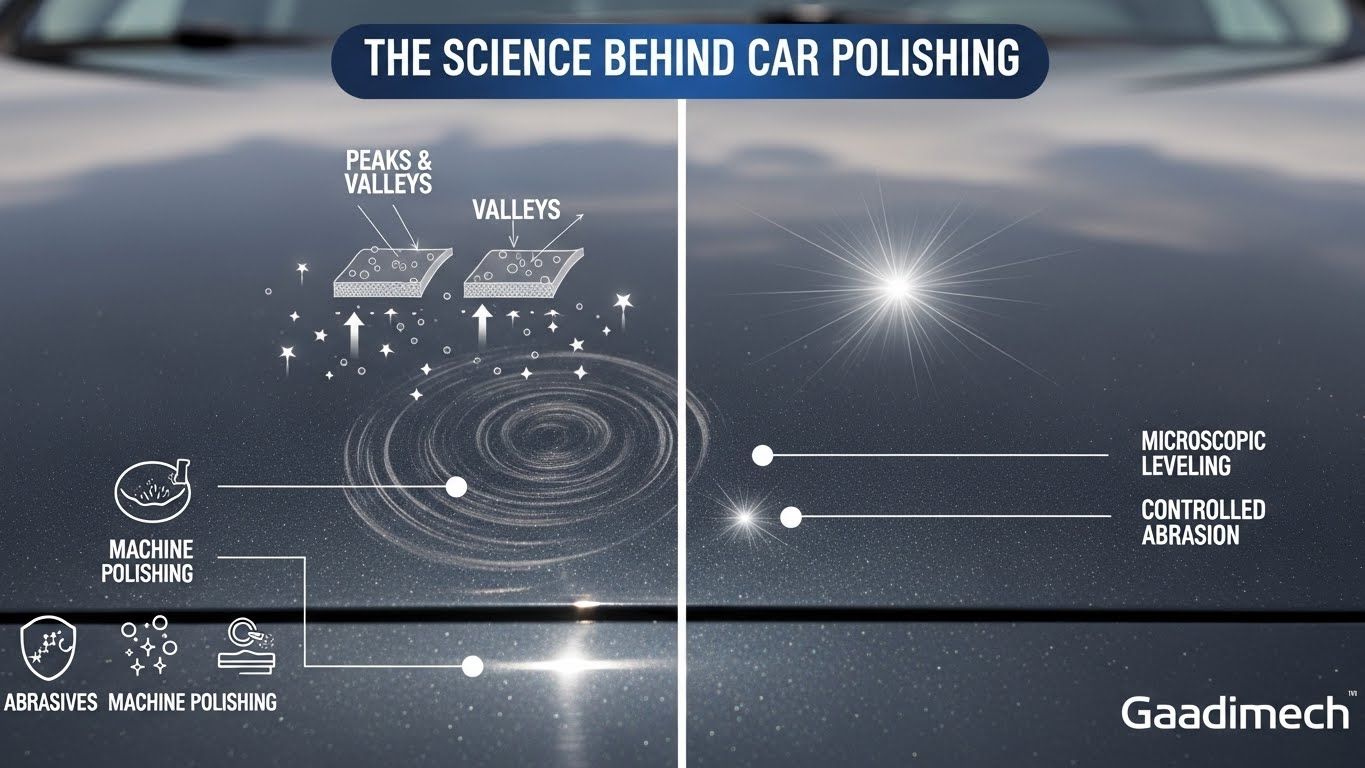
How Abrasives Remove Scratches: Microscopic Leveling
Polishing compounds contain hard particles (often engineered forms of aluminium oxide or silica) suspended in oils, water, or emulsifiers. As the pad moves across the paint, these particles shave down “high spots” in the clear coat around a scratch or swirl, gently flattening the surface. The scratch itself is not filled—it becomes less visible because the surrounding clear coat is brought down to its level. This controlled abrasion is why using the right cut level—and stopping in time—is critical for paint safety.
Safely handling swirl and scratch removal is best left to trained technicians at: Car Spa & Cleaning Services in Jaipur
How Light Reflection Changes After Polishing
Before polishing, microscopic peaks and valleys in the clear coat scatter light in many directions, which visually emphasises swirl marks, haze, and oxidation. Once the surface is levelled and refined, light can pass cleanly through the clear coat, hit the colour layer, and reflect back in a more uniform way, creating a deeper, glossier look. This is why the same paint colour can look flat on a scratched panel and “wet” or mirror-like after a proper polish.
For professional gloss enhancement and “showroom” finishes, explore: Car Spa & Cleaning Services in Jaipur
Cutting Compound vs Car Polish
Cutting compounds” and “polishes” are both abrasives, but they differ in how aggressively they remove material: Cutting compound
- Heavy or medium abrasives
- Used to tackle deeper scratches, heavy oxidation, and severe defects
- Removes more clear coat per pass, needs follow-up refining
Finishing / regular polish
- Much finer abrasives
- Used after cutting to remove micro-marring and restore high gloss
- Removes minimal clear coat, focuses on clarity and depth In a full paint correction, technicians start with cutting, then move through polishing and refining stages to reach a defect-free, mirror-like finish.
Diminishing Abrasive Technology and Chemistry Many modern polishes use “diminishing abrasives” that start relatively sharp, then break down into smaller, rounder particles as they are worked. At first, they cut more aggressively; as the particles fracture and become finer, the same product transitions into a refining polish, reducing the chance of leaving new haze.
Typical polish formulas also include:
- Solvents and surfactants – help clean oils and traffic film, and spread abrasives evenly
- Oils and lubricants – give working time and reduce the risk of dry spotting and micro-marring
- Polymers or silicones – add temporary gloss, slickness, and water behaviour, especially in “all-in-one” products Gaadimech uses professional-grade compounds and polishes matched to Indian conditions in its detailing work. Check available detailing options here: Car Spa & Cleaning Services in Jaipur
Hand Polishing vs Machine Polishing: The Science
Hand polishing relies on arm pressure and random motion, which is gentle but limited in cut; it’s suitable for very light defects or small areas. Machine polishing uses either dual-action (DA) or rotary machines that combine speed, pressure, and controlled movement to keep the abrasive particles working uniformly across the surface
- Dual-action polishers oscillate and rotate, spreading heat and reducing the risk of “burning” clear coat—safer for most users.
- Rotary polishers spin on one axis, cut faster, and generate more heat; they are powerful but demand high skill to avoid holograms or clear-coat damage.
Because machines can remove material quickly, depth of cut and working time must be carefully controlled.
Safe Thickness Removal and Mirror-Like Finish Steps
A typical factory clear coat is often in the range of only a few tens of microns, so professional detailers aim to remove just a few microns during correction. That’s why repeated heavy cutting over the car’s lifetime is not recommended; most vehicles only have “room” for a couple of major corrections before the clear coat becomes too thin.
A safe, science-based process for a mirror-like finish generally follows these steps:
- Deep wash and decontamination – pH-neutral wash, followed by clay bar or chemical decontamination.
- Paint inspection – lighting and, ideally, paint thickness gauge to understand defect depth and remaining clear coat.
- Compounding / cutting (if needed) – heavier compound with suitable pad to level deeper defects.
- Polishing / refining – finer polish to remove micro-marring from the cutting stage and restore clarity.
- Finishing and protection – application of wax, sealant, or ceramic coating to protect the newly levelled surface.
This approach combines minimal, controlled abrasion with long-term protection, giving a deep gloss while preserving paint life.
Conclusion or Summary
Car polishing is controlled micro-engineering of your clear coat: abrasives, chemistry, heat, and motion all work together to level defects and reshape how light reflects off your paint. When done correctly—with the right compounds, machines, and safe removal limits—it restores gloss without sacrificing longevity. For most owners, that level of precision is best handled by trained professionals using measured, step-by-step processes.