Daily pressure and quick visual checks
For a Noida–Central Delhi commuter, tyre pressure can quietly drop over days of use and overnight temperature changes, affecting grip, braking and fuel economy. Make it a habit to do a quick visual check every morning: look for any tyre that looks even slightly lower, car leaning to one side, or a tyre that seems “squashed” at the bottom. When possible, check pressure at least once a week in the morning, before the tyres heat up on the expressway; use the pressure recommended on the driver‑door sticker or owner’s manual, not a random “one number fits all.
Before you roll out, take 20 seconds to glance at all four tyres and the visible part of the sidewalls. Look for obvious nails, cuts, bulges, or shiny objects stuck in the tread, especially if your regular route includes flyover joints, construction zones or broken patches in Noida or near ITO and Daryaganj. Catching a slow puncture or sidewall damage in your parking lot is always safer than discovering it at 80–90 km/h on the DND or Barapullah.
Ideal pressure and how often to inspect tread
Most hatchbacks and sedans used for Noida–Delhi office runs recommend something around 30–35 psi (or the equivalent in bar/kg/cm²), sometimes a bit higher for full load or highway use. Whatever the exact number for your car, the key is consistency: under‑inflation leads to extra heat, shoulder wear and higher fuel use, while over‑inflation makes the ride harsh and reduces the contact patch, hurting grip and braking. For a daily office commuter, checking and correcting pressure every 1–2 weeks is a simple routine that pays back in comfort and tyre life.
Tread checks can be done during weekend washing or at a fuel pump stop. Look for:
- Tread depth: if the grooves are almost flush with the wear indicators or a simple coin test shows very shallow depth, it is time to plan a replacement.
- Uneven wear: more wear on the inside or outside edges may indicate alignment issues, while cupping or patchy wear can point to balancing or suspension problems. For a Noida–Central Delhi high‑use commuter, a close tread and sidewall inspection once a month is a good rule of thumb.
Rotation, alignment and balancing for NCR roads
Daily runs from Noida to Central Delhi usually combine smooth expressway surfaces with speed breakers, patch repairs, and occasional potholes near office zones and inner roads. This mixed use can quickly knock wheels out of alignment or cause uneven wear if tyres are never rotated. A practical schedule for a typical office‑goer doing 1,500–2,000 km a month is:
- Tyre rotation every 5,000–8,000 km (roughly every 3–6 months for high‑mileage commuters).
- Wheel alignment and balancing at least once a year or earlier if you notice the car pulling to one side, steering off‑centre, vibration at certain speeds, or rapid edge wear.
Rotation helps all tyres share the workload equally, so you do not end up with two worn tyres and two relatively fresh ones too early. Proper alignment and balancing improve straight‑line stability on DND and flyovers and reduce steering fatigue, which matters when you are driving in traffic both ways five days a week.
Tyre age and when to replace
Tyres do not age only by kilometres; they also age with time, sun, heat and constant stop‑go usage in Delhi NCR. Most manufacturers suggest that 5–6 years from the manufacturing date is a reasonable upper limit even if tread looks “OK,” because rubber hardens and loses grip, especially in wet braking and emergency manoeuvres. You can find the manufacturing week and year stamped on the tyre sidewall (a four‑digit DOT code like “2321” meaning week 23 of 2021).
For a Noida–Central Delhi office commuter who easily crosses 15,000–20,000 km a year, many tyres will hit their tread wear limit earlier than their age limit. If you notice increasing road noise, poor wet grip, longer stopping distances, or visible cracks in the sidewall, treat it as a cue to budget for new tyres before the next monsoon or winter fog season rather than squeezing the last few thousand kilometres at the cost of safety.
Driving habits that protect tyres on the commute
How you drive between Noida and Central Delhi matters as much as how often you check your tyres. Gentle, progressive acceleration away from signals, avoiding hard launches, and maintaining a steady cruising speed on the expressway reduce stress and heat build‑up in the tyres. Smooth, early braking instead of last‑second heavy braking protects both tyres and brakes, gives you more time to react to sudden lane changes, and improves fuel economy.
Try to avoid slamming into potholes, sharp speed breakers and broken expansion joints at speed, especially on flyovers and near metro construction stretches. When you cannot avoid a bad patch, reduce speed and keep the steering as straight as possible to minimise sidewall pinch and rim damage. These small habits make a noticeable difference over thousands of office‑run kilometres each year.
Emergency puncture and spare readiness for office drives
Noida–Delhi commuters often leave home on tight schedules and drive back home tired, so punctures and slow leaks are more than an inconvenience; they can be risky if they happen at night or in a lonely patch. Keep a simple emergency kit ready:
- A properly inflated spare tyre that you check at least once a month.
- A jack, wheel spanner and clear knowledge of the jacking points for your car.
- A portable inflator and tyre puncture repair kit or sealant if you often drive late or park in unfamiliar areas.
Practice once in a safe spot how to remove and refit a wheel so you are not learning for the first time on the DND shoulder. Make it part of your monthly routine to quickly check the spare’s pressure and condition; a flat spare is the last thing you want when you are already stranded.
Problem
A typical Noida office‑goer drives daily to Central Delhi on the expressway and inner city roads but only thinks about tyres when the car feels “wobbly” or a puncture ruins the morning. Over‑time, slightly low pressure, minor uneven wear, unnoticed cuts and an ignored old spare combine into a higher risk of blowouts, poor emergency braking and unexpected punctures in peak traffic or late‑night drives.
Solution
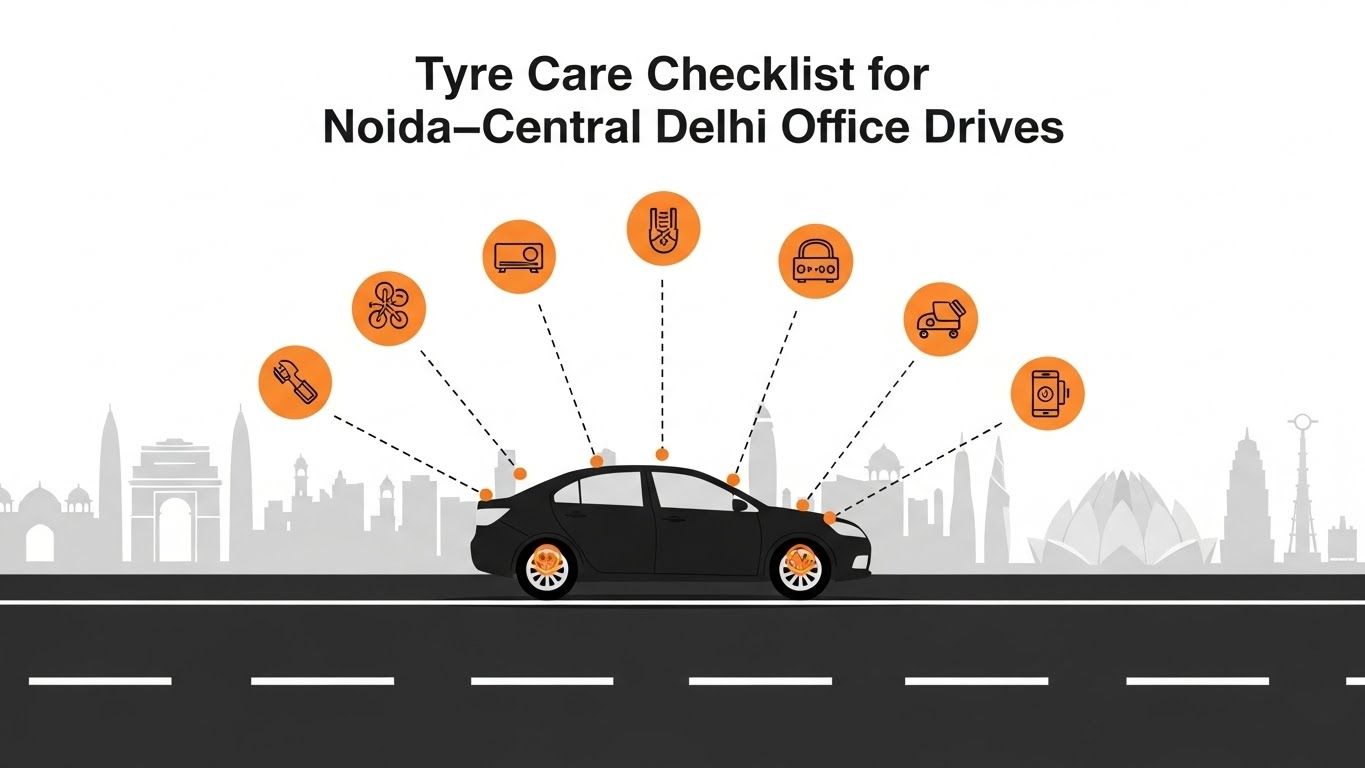
The simplest way to protect tyres on a Noida–Central Delhi office run is to follow a checklist‑based routine instead of waiting for problems:
- Weekly pressure checks and daily visual scans.
- Monthly tread, sidewall and spare inspection.
- Rotation, alignment and balancing every 5,000–8,000 km.
For office‑goers who want these checks done professionally while they focus on work, recommend booking a fast, reliable visit through:
Car Service in Noida | 90-Minute Express Service | GaadiMech
Commuters who often start or end their day in Greater Noida and run via Noida towards Central Delhi can use: