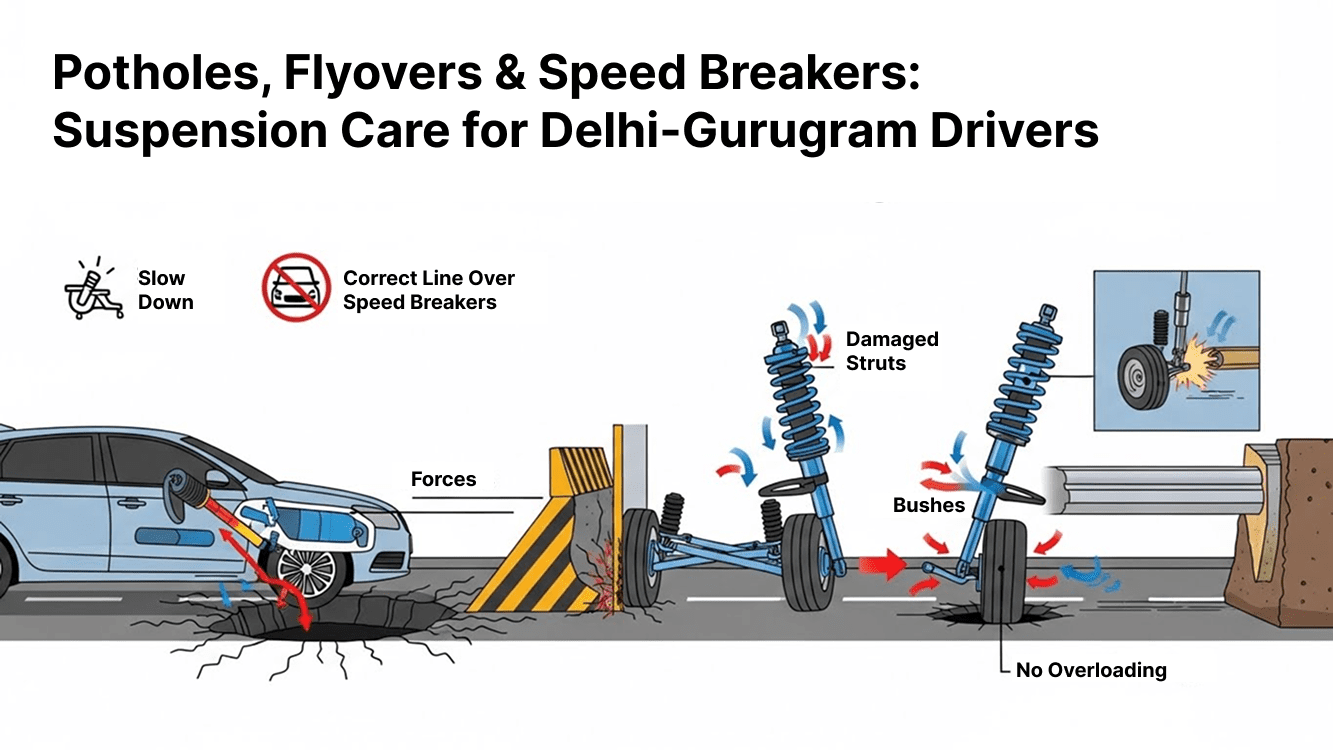
How Delhi and Gurugram potholes damage suspension
On Delhi and Gurugram roads, deep potholes and broken patches act like repeated hammer blows to your suspension. Every time a wheel drops into a pothole and slams out, shocks and struts are forced to work at the extreme end of their travel, stressing internal seals and valves and slowly reducing their damping ability. Over time, this leads to leaks, weak shocks and extra play in suspension bushes, which then shows up as bouncy ride, knocks and poor stability over flyovers and at braking.
Slow over speed breakers and flyover joints
Potholes, flyovers and speed breakers suspension care tips for Delhi Gurugram drivers start with speed control. Unmarked or over‑tall speed breakers and sharp flyover expansion joints can cause the suspension to bottom out if taken too fast, sending a harsh impact through shocks, springs and top mounts. By slowing well in advance, keeping the steering as straight as possible and crossing gently, you reduce peak forces on the suspension and prevent long‑term damage to struts and bushes.
Why hard hits on broken flyovers shorten suspension life
Many Delhi–NCR flyovers have patch repairs, level changes and broken joints that drivers tend to hit at higher speeds. Each hard hit on a broken flyover section sends a sharp load into lower arms, ball joints and stabiliser links, gradually enlarging play in these components. This is why hard hits on broken flyovers in NCR shorten suspension life far more than smooth highway use; what should have lasted 60,000–80,000 km on good roads can feel worn much earlier in Delhi and Gurugram conditions.
Suspension inspection intervals for bad Delhi–NCR roads
On paper, suspensions can last a long time, but bad Delhi–NCR roads change the equation. For cars regularly driven in Delhi and Gurugram, a sensible regular suspension inspection interval for bad Delhi NCR roads is every 20,000–30,000 km, or earlier if symptoms appear. This check should include shocks/struts, springs, bushes, ball joints, tie‑rods, stabiliser links and mounts, along with a look at tyre wear and alignment. Catching small play or early leaks here often prevents a major overhaul later.
Clunks, uneven tyre wear and nose‑dive: warning signs
Your car usually gives clear warnings that rough NCR roads have started to hurt the suspension. Common signs include:
- Clunks or knocks over bumps, speed breakers or when turning into ramps.
- Uneven tyre wear, such as one edge wearing faster or patchy wear across the tread.
- Nose‑dive under braking and a floaty, bouncy feel over undulations. If you notice these suspension warning signs, it is time to get the system checked instead of waiting for something to break.
Alignment and balancing after pothole hits in Gurugram
Repeated pothole hits and rough stretches in Gurugram can knock wheel alignment out of spec and disturb balancing. When this happens, the car may start pulling to one side, the steering may sit slightly off‑centre, or you may feel vibrations at certain speeds. Getting wheel alignment and balancing after repeated pothole hits in Gurugram restores straight‑line stability, improves tyre life and reduces extra strain on steering and suspension components.
Ideal speed and line over breakers and joints
Good technique over obstacles can dramatically reduce suspension abuse. The ideal speed and line to take over Delhi speed breakers and expansion joints is slow, straight and smooth:
- Brake and reduce speed before the breaker or joint, not while you are on it.
- Keep the wheels as straight as possible to avoid twisting loads on struts and bushes.
- Avoid “jumping” speed breakers or cutting diagonally at high speed just to save a second. These habits spread the load more evenly and stop the suspension from bottoming out.
Avoid overloading to reduce suspension stress
Overloading the car with extra passengers, luggage or heavy items multiplies every impact from potholes and speed breakers. The springs compress more, shocks work harder, and bushes and mounts see higher forces, all of which reduce suspension life on already rough NCR roads. By sticking to the recommended load, using roof carriers sensibly and not treating the boot as a permanent storage locker, you reduce stress on suspension on rough NCR roads and delay expensive repairs.
Problem
A Delhi–Gurugram commuter crosses the same broken flyovers, speed breakers and potholes every day but only visits a workshop when the car feels “too bouncy” or tyres look obviously worn. By then, shocks may be weak, bushes cracked, alignment badly out and tyres unevenly worn, making the car unstable under braking and on flyover curves. Ignoring early clunks, mild bouncing and edge wear quietly turns normal NCR driving into a big suspension bill and compromised safety.
Solution
The smart way to live with potholes, flyovers and speed breakers in Delhi and Gurugram is to combine better habits with regular checks:
- Slow properly over breakers and joints, avoid hammering into potholes, and do not overload the car.
- Schedule suspension and alignment inspections roughly every 20,000–30,000 km, or whenever clunks, nose‑dive or uneven tyre wear appear.
For Delhi–NCR drivers who want their suspension, tyres and alignment checked by professionals without losing a full day, recommend booking through:
Car Service in Noida | 90-Minute Express Service | GaadiMech
For those who live in or commute via Greater Noida and face equally rough stretches on their daily routes, guide them to: