How Delhi–NCR road conditions accelerate suspension wear
How Delhi–NCR road conditions accelerate wear on your car’s suspension comes down to constant high‑impact hits and uneven surfaces. Daily driving over broken tarmac, concrete joints, patches and sharp level changes forces shocks, struts and bushes to work at the limits of their travel far more often than on smoother highways. Over time, this extra punishment makes seals leak, internal valves weaken and rubber bushes crack or develop play, so components that might last very long in ideal conditions wear out faster in Delhi–NCR.
Potholes, unmarked speed breakers and flyover joints
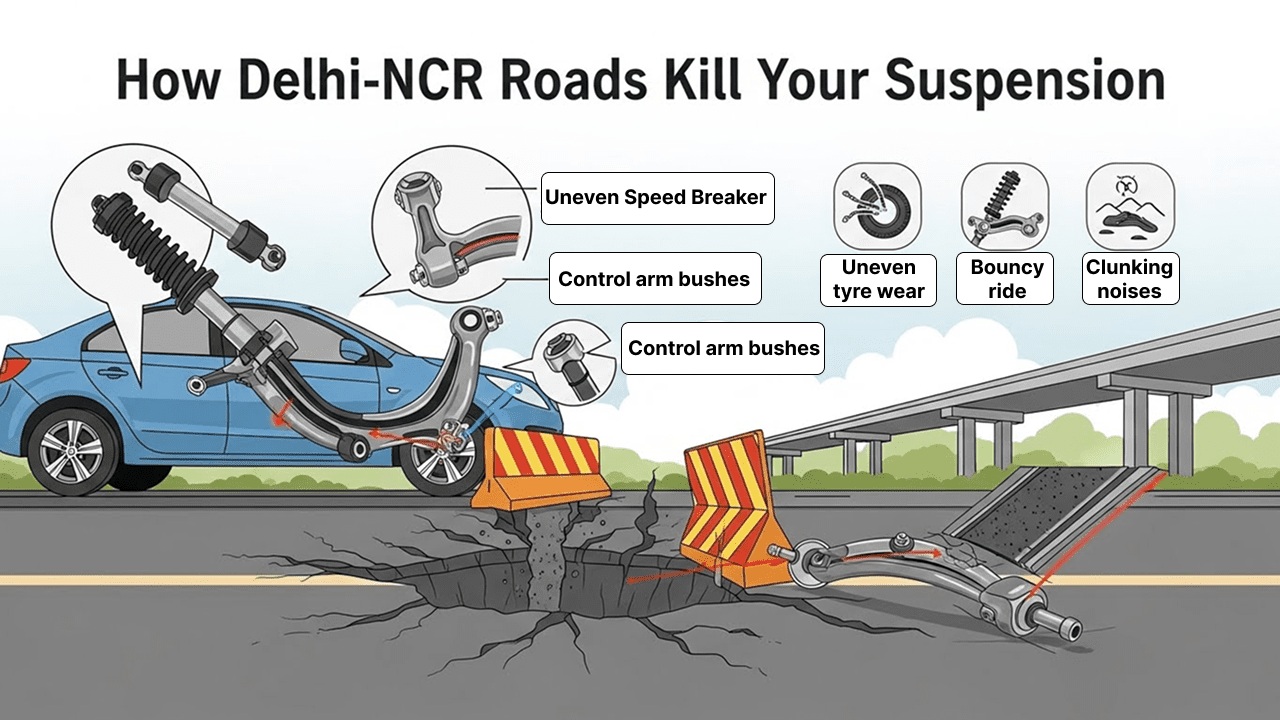
Deep potholes and unmarked speed breakers are among the biggest threats to shocks and struts in Delhi–NCR. A wheel dropping into a pothole and slamming out creates a sharp impact that can bend rims, damage struts and knock alignment out in a single hit. Speed breakers taken too fast can make the suspension bottom out, stressing springs, top mounts and dampers far beyond normal loads. Flyover joints and broken patches at entry/exit points act like repeated small potholes, and over months they contribute to premature suspension bush wear, especially in control arms and stabiliser links.
Uneven tyre wear, bouncy ride and clunks as damage signs
Suspension damage rarely appears all at once; instead, the car sends early signals. Uneven tyre wear, bouncy ride and clunking noises are classic signs that Delhi–NCR roads have started to take a toll. You might see one edge of the tyre wearing faster, feel the car continue to bounce after a speed breaker, or hear knocks over rough patches and when turning into ramps. These symptoms indicate that shocks may be weak, bushes may have play and alignment may be off, all of which reduce comfort and safety if left unchecked.
Suspension inspection interval for bad Delhi–NCR roads
On rough Indian roads, especially in Delhi–NCR, waiting for extremely high mileage before checking suspension is a mistake. A practical recommended suspension inspection interval for bad Delhi NCR roads is roughly every 10,000–15,000 km, or earlier if you notice clear symptoms like bounciness, clunks or unusual tyre wear. During these checks, technicians can examine shocks/struts, springs, control arm bushes, ball joints, tie‑rods and stabiliser links and also look at alignment and wheel/tyre condition, catching problems when they are still small and cheaper to fix.
Alignment, balancing and reducing strain on rough roads
Correct wheel alignment and balancing are essential allies for suspension health on Delhi–NCR roads. Misalignment from pothole hits or kerb strikes makes tyres scrub the road instead of rolling cleanly, increasing wear on both tyres and suspension joints. Balancing helps reduce vibrations that can contribute to looseness in fasteners and components over time. Getting alignment and balancing checked after repeated pothole hits or every few months of city use helps reduce strain on shocks, struts, bushes and steering parts on rough routes.
Driving habits that protect suspension
Driving style can dramatically change how quickly Delhi–NCR roads wear your suspension. The core habits are simple: slow over speed breakers and avoid sudden hits to protect shocks and mounts. Braking early before speed breakers and potholes, taking them at low speed with the steering mostly straight, and avoiding “launching” over humps reduces peak loads. Choosing smoother lines where possible and not swerving late into unknown patches also helps, especially at night and in rain when potholes and broken edges are harder to see.
How neglected suspension affects braking and steering
A healthy suspension keeps all four tyres in consistent contact with the road, which is essential for strong braking and precise steering. When shocks are weak or bushes have play, the car can bounce, nose‑dive or lean excessively, reducing how much of the tyre’s grip is available during hard braking or quick lane changes. This means neglected suspension affects braking distance and steering control, making emergency stops longer and the car less stable in sudden manoeuvres—critical on busy Delhi–NCR corridors, flyovers and expressways.
When to replace shocks, struts and bushes in Indian conditions
There is no single number for all cars, but in Indian conditions many shocks and struts start to lose effectiveness somewhere between medium and higher mileages depending on usage and load. In Delhi–NCR, where roads are harsher, it is wise to consider replacement when you see persistent bounciness, clear leaks from shocks, regular bottoming out, or repeated alignment and tyre‑wear issues that trace back to play in suspension parts. This is often the stage when to replace worn shocks, struts and control arm bushes in Indian conditions to restore safe handling and comfort rather than pushing tired components far beyond their effective life.
Suspension upgrade options for Delhi–NCR commuting
Some Delhi–NCR drivers who face daily broken stretches, village roads or heavy loads may benefit from carefully chosen suspension upgrade options. Gas‑charged shocks or slightly heavy‑duty dampers can offer better heat resistance and more consistent control on rough roads, while comfort‑focused setups can smooth out smaller imperfections. Upgrades should be chosen to balance Delhi NCR commuting comfort and durability—too stiff can hurt ride quality and stress other parts, while a well‑matched setup can reduce bounciness, improve body control and make bad roads more manageable day after day.
Problem
A Delhi–NCR commuter drives daily over potholes, broken flyovers and harsh speed breakers but only visits a workshop when the car feels “too bouncy” or tyres look badly worn. By then, shocks may be weak, bushes cracked, alignment badly out and tyres unevenly worn, making the car unstable under braking and vague in steering. Ignoring earlier signs like light clunks, mild bouncing and edge wear quietly converts normal daily driving into a major suspension repair and a safety risk.
Solution
The smarter way to live with Delhi–NCR roads is to combine better driving habits with a strict inspection routine:
- Adopt a 10,000–15,000 km suspension and alignment inspection interval on bad roads, or sooner if warning signs appear.
- Slow properly over speed breakers and flyover joints, avoid sudden hits into potholes and do not overload the car. For NCR drivers who want their suspension, tyres and alignment checked by professionals without losing a full day, guide them to:
Car Service in Noida | 90-Minute Express Service | GaadiMech
Regular Noida–Greater Noida and Delhi–NCR commuters can also book via: